The AI Experts at Texas A&M University Libraries
By Marketing and Communications | 12-12-2025
Universities everywhere are trying to define the role of artificial intelligence (AI) in research and academics.
Students and faculty are asking the same questions about AI. What is its future role? How will it affect me? Texas A&M University Libraries are quickly becoming experts at delivering answers.
“It's very much our responsibility to stay on top of the new tools that are coming out and the claims that they're making, testing them whenever we can,” said Esmeralda Rodgers, evidence synthesis librarian.
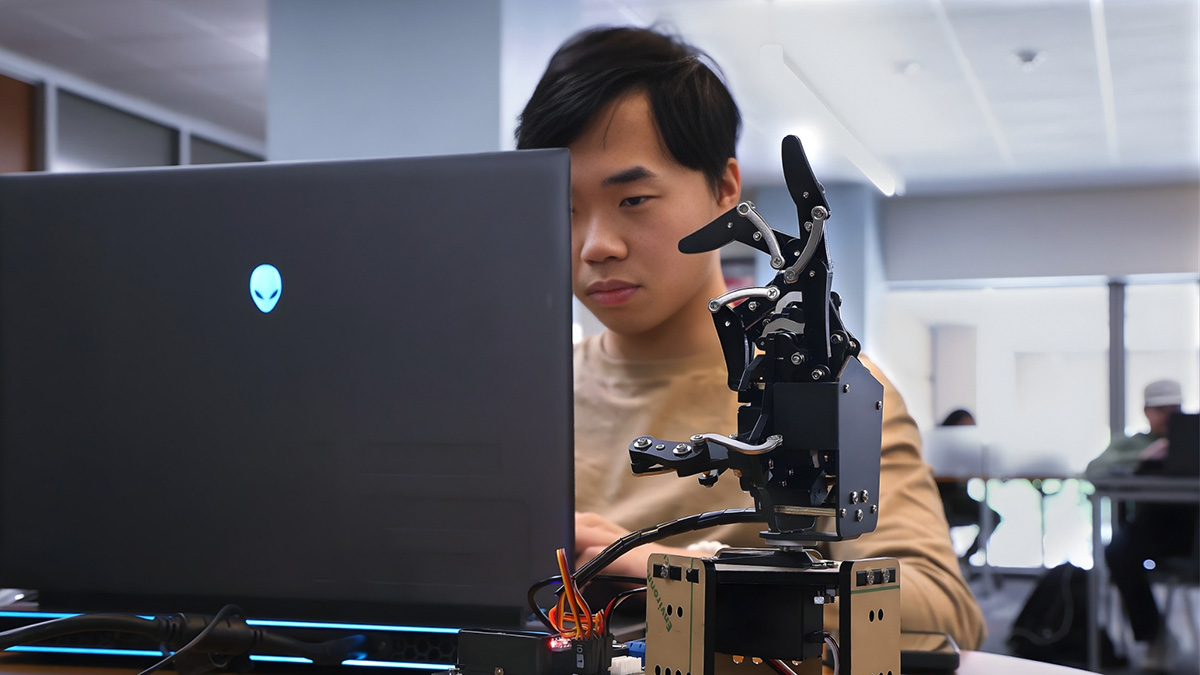
Organizing AI Chaos
The ability to go slow is rarely presented as an option today, but pausing for examination is vital when using new and rapidly-developing technologies. Rodgers encourages the following three steps with AI:
- Experiment with a variety of AI apps because they produce different results;
- Validate, validate and validate again;
- Take into consideration data privacy and what the AI is learning from inputs.
“You can use AI to summarize literature, to kind of give you ideas of what you want to search for,” Rodgers said. “But it is not a replacement for critical judgment and subject expertise.”
Rodgers is part of a team of librarians focused on using AI to process large amounts of information from multiple sources to answer specific research questions. As part of her exploration, she is experimenting with creating an AI agent — a “digital worker” — with a large knowledge base that guides users.
Her primary goal is training the AI agent to focus on systematic reviews, a common summary research step that requires sifting through vast amounts of data.
Academic AI Support for Faculty
The Libraries help Aggie scholars productively incorporate AI into their work and studies, with workshops, an online AI literacy tutorial series and curriculum support.
“We’ve seen an uptick in requests for AI content and one-shot lessons over the last few semesters from faculty,” said Alex Mitchell, director of University Libraries’ information literacy office.
To better support faculty, her team created a series of AI-related lesson packages with interactive elements, slide decks and optional ways to extend learning.
“Our lessons are divided into four overarching themes: AI 101, your basics of AI ethics, prompt engineering or prompt crafting, and AI for background research and question development,” Mitchell said.
Students, AI & the Aggie Honor Code
At the University Libraries location on the Texas A&M University at Galveston campus, Learning and Engagement Librarian Kerri Foley supports the freshman class by expanding their baseline AI skills and understanding.
“We’ve learned how they’re already using AI academically,” Foley said. “It’s mostly for practice problems, outlining, brainstorming and summarization. That baseline allows us to design materials that will meet the students where they are.”
For fall ’26, Foley and her team are developing an interactive learning module about AI that instructors of Texas A&M at Galveston’s first-year experience course, Hullaballoo U, can use. The module will cover basic AI literacy, non-AI alternatives, library resources and AI ethics — addressing what’s acceptable and why.
“I would like the students to pull up their syllabi and find those AI policies on there,” said Foley. “They need to be aware so that they’re on the right side of the Aggie Honor Code.”

Applying AI to the Real World
As students determine how to use AI honorably in the classroom, they’re also learning how to use it in the real world with help from Texas A&M librarians.
Texas A&M pharmacy students and Medical Sciences Library staff use a large language model AI to role play difficult patient conversations. This new tool allows them to practice discussing diagnoses with a variety of character simulations before they need to do so with patients.
The staff also analyzes various AI clinical tools available to students, faculty and medical professionals to develop best practices for current and future Aggie medical students.
For example, Margaret Foster ’98, director of the Center for Systematic Reviews and Research Synthesis, heads a team of medical science library staff in evidence synthesis — a structured method to analyze data related to specific questions.
Foster said the “how” behind every search result is more important than ever.
“We want to really make sure that we’re picking the best resources and doing the best methods because these become the backbone of clinical guidelines and policies,” Foster said.

Texas A&M University Libraries
Follow Us on Instagram
Written by: Ivy Mestrovic | Media Contact: Matthew Kennedy, matthew.kennedy@tamu.edu.
About Texas A&M University Libraries
Comprising six unique libraries, the Texas A&M University Libraries are a hub of resources, spaces and professionals supporting the success of research, learning and teaching. The Libraries advance student success and partner in innovative research, while providing a physical and digital home to all students, staff, faculty and researchers. To learn more visit library.tamu.edu.