A Cushing Collection Permanently Links Texas A&M and France
By Marketing and Communications | 12-12-2025
“Qu’ils mangent de la brioche” – or in English, “let them eat cake.” Did Marie Antoinette actually say that during the French Revolution? Probably not.
But she did say a lot of things – and they’re dramatized in season 2 of “Marie Antoinette,” the tale of one of history’s most storied monarchs. Both seasons are available to stream at PBS.org.
The French Revolution may have happened over 225 years ago and 5,000 miles away, but there’s a strong connection to that turbulent era of history in one of the finest French literature collections this side of France — housed at the Texas A&M University Libraries’ Cushing Memorial Library & Archives.
THE DAWSON FRENCH COLLECTION
Visiting Texas A&M’s Cushing Memorial Library & Archives is like stepping back in time. The 1920s architecture remains well maintained. But the architecture wraps around something even rarer: collections like the Robert L. Dawson French Collection.
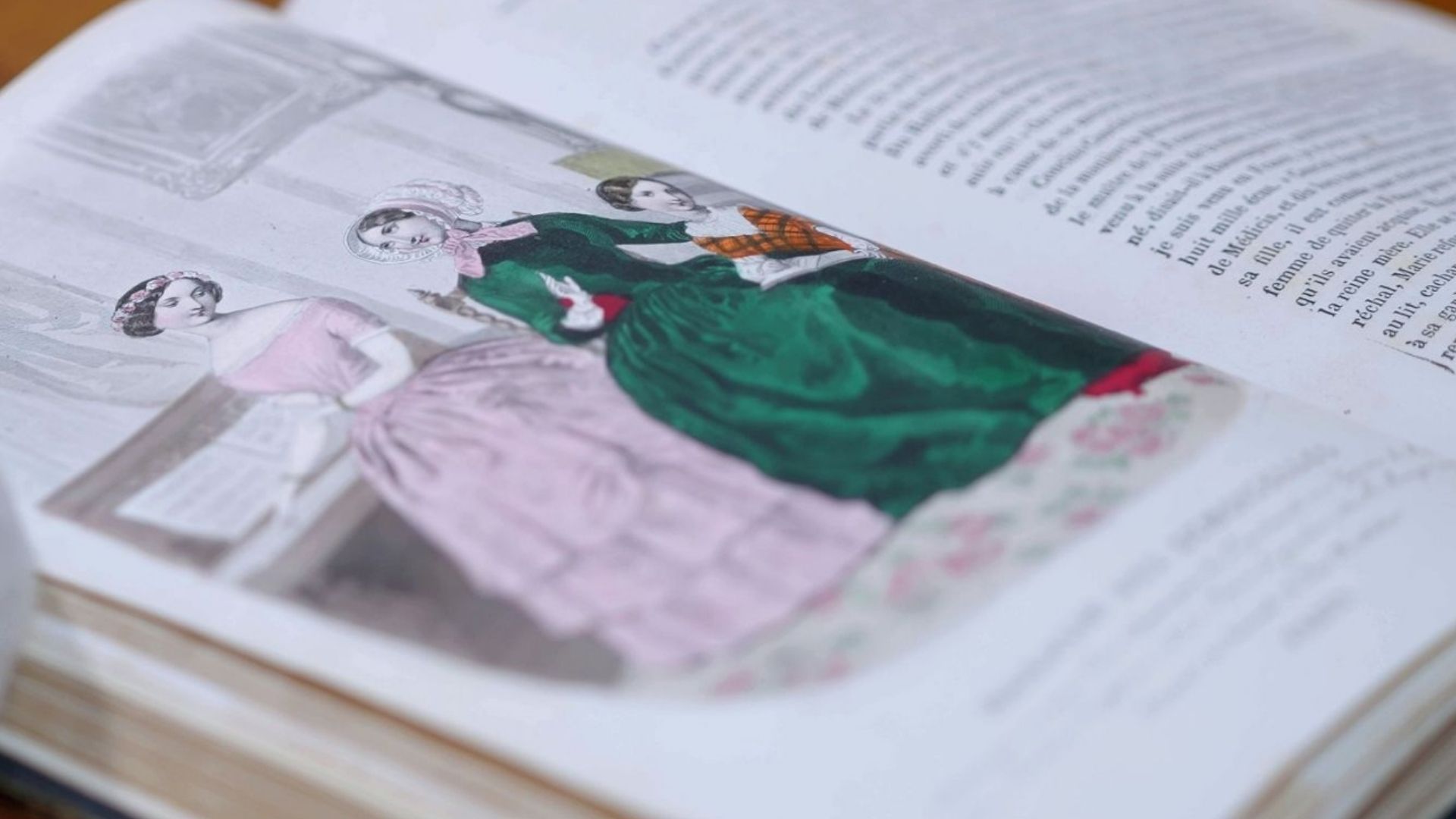
Shelves and shelves and shelves of French books, manuscripts, plays, letters and more – a total of more than 20,000 items that span five centuries – live in a climate-controlled area in a closed Cushing stack.
“We have items in our collection and the only other institution that may own a copy is the National Library of France,” said Felicia Piscitelli, rare books cataloger and curator of the Dawson French Collection. “Or we may have the only copy. We have some pretty neat stuff.”
Piscitelli has cataloged books at Cushing since 2009 and took over curatorship of the Dawson collection in 2022. She said the collection’s strength is in the 18th century (the embattled Antoinette lived from 1755-1793), but that it spans more: from roughly the 15th century to the first half of the 20th.
“It has a great deal of scope,” she said. “Literature, writings, essays, poetry, drama, a lot of theater and opera. Religious works.”
There are writings of Voltaire, collections of French laws dated with the revolutionary calendar, one of the first printings of “Les Miserables,” an official dictionary, magazines for young ladies, documents establishing public libraries and more.
“Books like these are not easy to get,” Piscitelli said.
WHO WAS ROBERT DAWSON?
Americans aren’t always welcomed overseas, but Robert Dawson wasn’t an ordinary tourist. Known as an avid collector, he frequented Paris' bookshops and auction houses with delight, and was so well-known that he was greeted as a friend. He was as enamored with forgotten authors as he was with famous names like Voltaire and Jean-Jacques Rousseau.
But Austin was his home. Dawson worked as a French professor at the University of Texas from 1975 until he died in 2007. He had two degrees from Yale, was fluent in French and Portuguese and proficient in Italian and Spanish, and he kept the majority of his collection in his cramped university office, packing every free inch with shelves.
An exhibit catalog produced by Cushing in 2008 said even the shelves weren’t enough: “The floor was covered with boxes and bags of books, and the lone desk had long since surrendered its original role as a work surface in favor of being another spot to stack new arrivals or old gems.” He made his library available to anyone – serious researchers and curious students alike. It was never meant to be looked at; it was always meant to be used.
Cushing acquired the collection from Professor Dawson a few years before his death and brought it to College Station. It took two large rental trucks and a minivan. “The movers planned for only one truck,” the catalog said, “but part way into the move added another out of fear the load would burst the tires.”
A LIVING, BREATHING COLLECTION
The majority of the collection may be more than 200 years old, but each page tells a relevant story.
“Collections like this give us a sense of how we got to where we are,” Piscitelli said. “If we forget what happened in the past, we’re likely to repeat it. The French Revolution – do we really want to go through that again? I don’t think so.”
Piscitelli described an inherent vibrancy to the collection – almost as if the love, care or anger put into each work can be felt and seen.
“After a while, you get to know authors and publishers in a familiar way,” she said. “You start to recognize the unique ways they do things.”
Much of the collection remains in good shape. In the 1700s, Piscitelli said bindings were more substantial and paper was made from linen or cotton rag.
“The fibers are less acidic and stronger than wood pulp paper, which came about in the late 19th century,” she said. “Books printed in the 1880s or 90s are already crumbling, whereas books from the 1790s are still in better condition.”
Curators have kept Professor Dawson’s vision alive over the years by sharing the collection with language classes and researchers. They also keep it growing. Piscitelli adds items that are topical and fit into the time period.
“My latest purchase was printed in 1699, and it’s a collection of essays asking when the new century starts: 1700 or 1701,” she said. “It’s like Y2K 300 years earlier.”
MARIE ANTOINETTE
The collection features many items from the revolutionary period. Piscitelli browsed the collection to find a few referencing Marie Antoinette. A defamatory book of essays about her life was published in 1789. “The year the revolution started and they were already saying bad stuff about her,” Piscitelli said.
Marie Antoinette was regularly criticized as the French people became more and more unhappy with the monarchy. There’s a book from 1794 tying her to causes for the revolution. And there’s a memoir supposedly written by Madame Comtesse de la Motte detailing the Affair of the Diamond Necklace, in which Marie Antoinette was falsely accused of defrauding jewelers, further ruining her reputation with the public.
But there are also items in support of the king and queen. There are funeral elegies for Louis XVI. There’s a 20,000-signature petition defending the king from revolutionary threats. And there’s a Latin prayer book, translated and dedicated to the queen.
MAKING THE COLLECTION AVAILABLE
Most of the collection is properly cataloged, but Piscitelli estimates she has at least 1,000 titles left. She puts her undergraduate French minor to work reading documents, analyzing authors and scouring bibliographic sources to identify each item and write a proper description. She’s also looking for printing errors. They make items even rarer – and it’s important to include those details in descriptions.
“It will take a long time to get through the last thousand,” she said. “The description for rare books is more involved than it is with modern books.”
Piscitelli encourages interest in using the collection. She’s worked with enough rare books by now to know not everything is digitized.
“There’s an idea that everything is available online now, but that is not the case,” she said. “Plus, the likelihood that you can go on Amazon or eBay and get a book like this is pretty dicey.”
Every item in the catalog is available to request and view in the Kelsey Reading Room at Cushing. Interested students, teachers or researchers should visit the library website, which explains the process for requesting items and scheduling time to view them. Au revoir!
This story was originally written and published by KAMU TV in March 2025.
Texas A&M University Libraries
Follow Us on Instagram
Media Contact: Matthew Kennedy, matthew.kennedy@tamu.edu.
About Texas A&M University Libraries
Comprising six unique libraries, the Texas A&M University Libraries are a hub of resources, spaces and professionals supporting the success of research, learning and teaching. The Libraries advance student success and partner in innovative research, while providing a physical and digital home to all students, staff, faculty and researchers. To learn more visit library.tamu.edu.